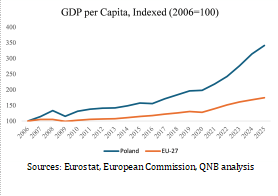
Over the past three decades, Poland has completed one of the most successful economic transformations in modern Europe. Since the end of central planning in 1989, market-oriented reforms, accession to the European Union, and deep integration into Western European supply chains have supported a sustained process of income convergence. The result is an economy of considerable scale: Poland’s nominal GDP has now surpassed USD 1 Tn, placing the country at the threshold of the world’s 20 largest economies. The US has invited it to take part as a guest in the G20 during its 2026 presidency. Global financial markets are also increasingly recognising this progress. In August, S&P Dow Jones Indices upgraded Poland from emerging to developed market status, effective with its September 2027 index reconstitution.
The decision brings S&P Dow Jones Indices into line with FTSE Russell and Stoxx, which reclassified Poland as a developed market in 2018. The index provider’s assessment covers macroeconomic and political stability, market size and liquidity, and accessibility to foreign investors. It concluded that Poland meets developed-market thresholds, noting the country’s resilience through economic and political challenges, including inflationary pressures and delays to public investment. In our view, the reclassification formally acknowledges the institutional and economic progress achieved over recent decades which has brought Poland significantly closer to a developed-economy status, and that Poland’s economic fundamentals now match developed-market standards. In this article, we discuss the three main factors behind this assessment: sustained growth outperformance, a track record of macroeconomic stability, and the deepening of domestic capital markets.
First, Poland continues to deliver growth well above that of its European peers, even amid a renewed energy shock. According to Statistics Poland (GUS), the economy expanded by 3.6% in 2025, and GDP growth accelerated to 3.9% year-over-year in the second quarter of 2026, up from 3.5% in the first quarter of 2026. By comparison, Eurostat data show that the European Union as a whole grew by 1.4% year-over-year. This performance is notable because the escalation of the US-Iran conflict pushed up oil and natural gas prices during the same quarter. Looking ahead, the European Commission forecasts growth of 3.5% for 2026 and 2.8% in 2027, placing Poland among the fastest-growing economies in the EU in both years.
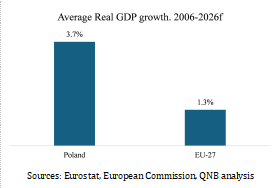
Importantly, growth is increasingly driven by investment, which supports the sustainability of the expansion. According to GUS, gross fixed capital formation rose by 8.4% year-over-year in the second quarter. The European Commission expects investment contribution to growth to increase further, based on a rising domestic share of new defence spending. Poland has secured the largest allocation under the EU’s Security Action for Europe (SAFE) defence instrument. Private capital adds a further structural anchor as the stock of inward foreign direct investment reached around USD 345 Bn in 2024. This is equivalent to about 38% of GDP and reflects Poland’s deep integration into European production networks.
Second, Poland has demonstrated a track record of macroeconomic stability, anchored by a credible monetary policy framework. After inflation peaked above 18% in early 2023, the National Bank of Poland’s (NBP) tightening significantly contributed to bring it back within its target range of 2.5% ±1 percentage point. This allowed the NBP to cut its reference rate by a total of 200 b.p. since 2025 to 3.75%. The recent energy shock has tested this framework. Headline inflation rose to 3.4% in August, but remains just below the upper limit of the target band. The European Commission expects inflation to ease to 2.9% in 2027, depending on the evolution of global commodity prices. Fiscal policy, however, remains a weak point. A deficit of 7.3% of GDP in 2025, the second highest in the EU, makes fiscal consolidation after the November 2027 parliamentary elections a key topic to be addressed to preserve macro-economic stability.
Last but not least, Poland’s capital market is deepening and attracting a growing share of international investors. According to the Warsaw Stock Exchange (WSE), the WIG20, a major stock market index that tracks the 20 largest and most liquid blue-chip companies listed domestically, gained 30.8% in total return terms through early September. This compares with 12.0% for the S&P 500 and 11.6% for MSCI World. Foreign investors accounted for a record 73% of trading on the WSE Main Market in the first half of the year, while primary market activity has revived, with ten IPOs so far this year. The final hurdle is an upgrade by MSCI, which still classifies Poland as an emerging market. The WSE expects such an upgrade within the next three to five years.
All in all, the S&P Dow Jones Indices upgrade formally recognises what Poland’s fundamentals have signalled for some time: sustained growth outperformance increasingly driven by investment, a credible monetary policy framework, and a deepening capital market. Developed market status should broaden Poland’s investor base and gradually lower its cost of capital. Going forward, two milestones will shape Poland’s future macro-economic trajectory: credible fiscal consolidation after the 2027 elections, and an upgrade by MSCI, which would firmly anchor the country among the world’s developed markets.
DISCLAIMER: The information in this publication (“Information”) has been prepared by Qatar National Bank (Q.P.S.C.) (“QNB”) which term includes its branches and affiliated companies. The Information is believed to be, and has been obtained from, sources deemed to be reliable; however, QNB makes no guarantee, representation or warranty of any kind, express or implied, as to the Information’s accuracy, completeness or reliability and shall not be held responsible in any way (including in respect of negligence) for any errors in, or omissions from, the Information. QNB expressly disclaims all warranties or merchantability or fitness for a particular purpose with respect to the Information. Any hyperlinks to third party websites are provided for reader convenience only and QNB does not endorse the content of, is not responsible for, nor does it offer the reader any reliance with respect to the accuracy or security controls of these websites. QNB is not acting as a financial adviser, consultant or fiduciary with respect to the Information and is not providing investment, legal, tax or accounting advice. The Information presented is general in nature: it is not advice, an offer, promotion, solicitation or recommendation in respect of any information or products presented in this publication. This publication is provided solely on the basis that the recipient will make an independent evaluation of the Information at the recipient’s sole risk and responsibility. It may not be relied upon to make any investment decision. QNB recommends that the recipient obtains investment, legal, tax or accounting advise from independent professional advisors before making any investment decision. Any opinions expressed in this publication are the opinions of the author as at the date of publication. They do not necessarily reflect the opinions of QNB who reserves the right to amend any Information at any time without notice. QNB, its directors, officers, employees, representatives or agents do not assume any liability for any loss, injury, damages or expenses that may result from or be related in any way to the reliance by any person upon the Information. The publication is distributed on a complementary basis and may not be distributed, modified, published, re-posted, reused, sold, transmitted or reproduced in whole or in part without the permission of QNB. The Information has not, to the best of QNB’s knowledge, been reviewed by Qatar Central Bank, the Qatar Financial Markets Authority, nor any governmental, quasi-governmental, regulatory or advisory authority either in or outside Qatar and no approval has been either solicited or received by QNB in respect of the Information.