
Global trade was the driving economic force of the early twenty-first century. Between 2000 and 2024 world trade in goods and services nearly quadrupled, and the ratio of trade to global output climbed to a peak of around 60% in 2008. The global financial crisis was the culmination of an era often described as hyper-globalisation. Since then, momentum has faded, and more recently a wave of tariffs and trade restrictions has pushed the world trading system into its most turbulent period in decades. Understanding this shift matters, because trade has been one of the most powerful engines of global growth and poverty reduction of the modern era.
In this article, we discuss three phases in the evolution of global trade: the rapid expansion of the 2000s, the "slowbalisation" that followed the global financial crisis, and the recent surge in protectionism now reshaping global commerce.
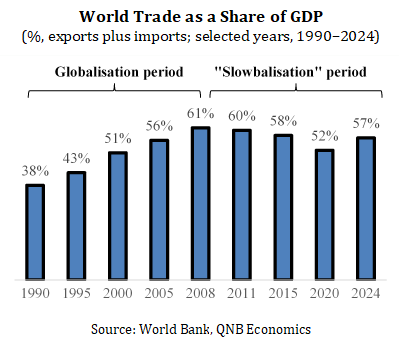
First, the opening decade of the century saw an extraordinary deepening of trade integration. China's accession to the World Trade Organization in 2001, the proliferation of global value chains, and steady declines in trade costs allowed goods, components and services to trade between borders like never before. This was aided by the increased standardisation of containers in shipping, growth of information technology and successive rounds of tariff liberalisation. Trade consistently expanded around twice as fast as global output, lifting the trade-to-GDP ratio sharply and drawing emerging economies into the heart of the world trading system. The share of emerging markets in the total global trade rose from roughly a quarter in the early 2000s to some 40% today, transforming the geography of global commerce.
Second, the 2008 global financial crisis marked a turning point. After the dramatic collapse and rebound of 2009 and 2010, trade growth settled into a markedly slower gear. The ratio of trade growth to global growth fell from roughly two-to-one before the crisis to around one-to-one afterwards, as the expansion of global value chains matured and large economies such as China rebalanced toward domestic demand. Trade openness plateaued rather than climbed, giving rise to the term "slowbalisation" to capture an era of still-substantial but no longer rapidly deepening integration.
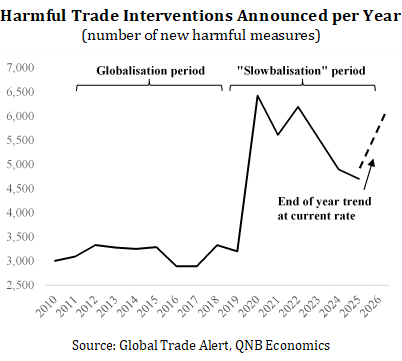
Third, and most consequentially, the trading system has entered a more contentious phase defined by rising protectionism. According to the “Global Trade Alert”, the number of new trade-restrictive measures introduced worldwide has roughly doubled from the 2010s decade to the 2020s decade, from around 3,000 per year to around 6,000 per year. Over the past year, the value of imports affected by new tariffs and other import measures rose more than fourfold, the highest coverage in over fifteen years of monitoring. Successive rounds of tariff increases and retaliation among major economies, together with a broader turn toward industrial policy and supply-chain "de-risking", have lifted both tariffs and trade-policy uncertainty far above historical norms.
The consequences are already visible in the near-term outlook. Having grown by close to 3% in 2024, world merchandise trade is expected to slow sharply, and the WTO has repeatedly warned that the spread of trade-restrictive measures and policy uncertainty represents the principal downside risk. Trade fragmentation increasingly runs along geopolitical lines, with commerce redirected toward partners perceived as more reliable. This process raises costs, dampens efficiency and weighs on global productivity over time.
All in all, global trade has moved through three distinct eras in a single generation: from the hyper-globalisation of the 2000s, through the “slowbalisation” of the 2010s, to today's more fragmented and policy-constrained landscape. Trade has nonetheless proved remarkably resilient, with new agreements being forged and supply chains reconfigured rather than dismantled. But the era of ever-deepening, rules-based integration has given way to one in which trade is increasingly shaped by strategic and geopolitical considerations. This has significant implications for global growth, prices and the development prospects of emerging economies that have relied on open markets to catch up.
DISCLAIMER: The information in this publication (“Information”) has been prepared by Qatar National Bank (Q.P.S.C.) (“QNB”) which term includes its branches and affiliated companies. The Information is believed to be, and has been obtained from, sources deemed to be reliable; however, QNB makes no guarantee, representation or warranty of any kind, express or implied, as to the Information’s accuracy, completeness or reliability and shall not be held responsible in any way (including in respect of negligence) for any errors in, or omissions from, the Information. QNB expressly disclaims all warranties or merchantability or fitness for a particular purpose with respect to the Information. Any hyperlinks to third party websites are provided for reader convenience only and QNB does not endorse the content of, is not responsible for, nor does it offer the reader any reliance with respect to the accuracy or security controls of these websites. QNB is not acting as a financial adviser, consultant or fiduciary with respect to the Information and is not providing investment, legal, tax or accounting advice. The Information presented is general in nature: it is not advice, an offer, promotion, solicitation or recommendation in respect of any information or products presented in this publication. This publication is provided solely on the basis that the recipient will make an independent evaluation of the Information at the recipient’s sole risk and responsibility. It may not be relied upon to make any investment decision. QNB recommends that the recipient obtains investment, legal, tax or accounting advise from independent professional advisors before making any investment decision. Any opinions expressed in this publication are the opinions of the author as at the date of publication. They do not necessarily reflect the opinions of QNB who reserves the right to amend any Information at any time without notice. QNB, its directors, officers, employees, representatives or agents do not assume any liability for any loss, injury, damages or expenses that may result from or be related in any way to the reliance by any person upon the Information. The publication is distributed on a complementary basis and may not be distributed, modified, published, re-posted, reused, sold, transmitted or reproduced in whole or in part without the permission of QNB. The Information has not, to the best of QNB’s knowledge, been reviewed by Qatar Central Bank, the Qatar Financial Markets Authority, nor any governmental, quasi-governmental, regulatory or advisory authority either in or outside Qatar and no approval has been either solicited or received by QNB in respect of the Information.