

For the years immediately following the Global Financial Crisis, Spain was emblematic of Europe's economic malaise. In the aftermath of a collapsed housing bubble and the Euro area sovereign debt crisis, it was grouped among the vulnerable peripheral economies whose solvency markets openly questioned. Unemployment peaked at over 26% in 2013, the banking system required a EUR 100 billion rescue, and the public deficit had reached double digits. Today, the picture could hardly be more different. Spain has become one of the best-performing advanced economies, expanding by 3.2% in 2024 and 2.8% in 2025, far outpacing a Euro area growing at little more than 1%. It is expected to lead the currency bloc again in 2026.
This turnaround reflects a combination of a hard-won structural adjustment and favourable tailwinds that have reshaped the Spanish growth model. Once overly reliant on construction and vulnerable to external shocks, the economy today rests on a broader and more resilient base. In this article, we discuss three factors behind Spain's transformation: a more competitive and diversified export base, a demographic and labour-market revival, and supportive investment and energy dynamics.
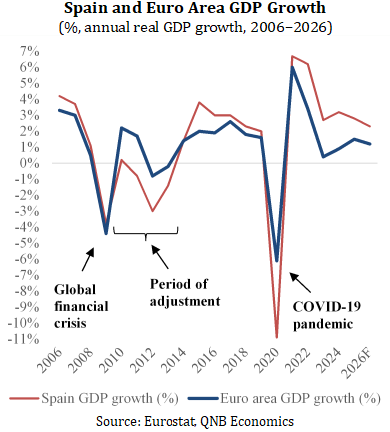
First, painful post-crisis adjustment restored competitiveness and broadened the economy's export base. In the years after 2010, sweeping labour-market reforms were introduced that promoted stable, permanent employment. Wage moderation also drove down unit labour costs, making Spanish firms more competitive internationally and fuelling an export recovery. In addition, the government restructured and merged fragile regional savings banks, which helped stabilise the financial sector. Spain also positioned itself as a major hub for foreign greenfield projects and tech talent, aided by digital nomad initiatives. These improvements allowed the Spanish economy to expand to higher value-added services exports in areas such as finance, information technology and professional services. The result was an economy more diversified and better insulated from shocks, and a shifting from historical chronic trade deficits to posting record current account surpluses.
Second, a demographic and labour-market revival have become powerful engines for growth. Where the Global Financial Crisis destroyed more than three million jobs, employment has since rebounded to record highs, and unemployment, though still among the highest in the Euro area, has fallen to around 10%, less than half its 2013 peak. A significant driver has been immigration of highly skilled labour, mainly from culturally adjacent Latin America. This expanded the working-age population and labour force at a time when much of Europe was ageing and shrinking. This inflow of workers also supported consumption, eased skilled labour shortages and lifted the economy's overall growth potential, helping Spain achieve some of the strongest productivity gains among Europe's largest economies in recent years.
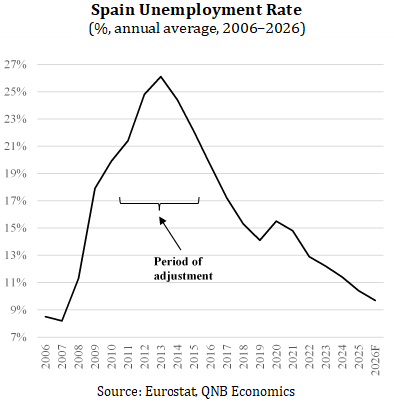
Third, supportive investment and energy dynamics have reinforced the recovery. Spain is a major beneficiary of the European Union's post-pandemic recovery programme, which is channelling substantial funds into investment and modernisation across the economy. At the same time, the country's heavy investment in renewable energy and its limited reliance on imported gas cushioned it from the worst of the recent energy price shocks that weighed so heavily on more energy-dependent neighbours such as Germany. Combined with healthier household and corporate balance sheets after years of deleveraging, these factors have underpinned robust domestic demand while keeping the public finances on a gradually improving path, with the debt ratio now declining.
All in all, Spain's journey from crisis casualty to growth leader illustrates how structural reforms, diversification and favourable tailwinds can together transform an economy's fortunes. Challenges undoubtedly remain: unemployment is still high by European standards, public debt hovers near 100% of GDP, and sustaining strong productivity growth over the long term is challenging. Nonetheless, the contrast with the depths of the debt crisis is striking. Having once been counted among Europe's most fragile economies, Spain now stands out as one of its most dynamic. This serves as a reminder that even the continent's hardest-hit economies can, with time and reform, stage a durable recovery.
DISCLAIMER: The information in this publication (“Information”) has been prepared by Qatar National Bank (Q.P.S.C.) (“QNB”) which term includes its branches and affiliated companies. The Information is believed to be, and has been obtained from, sources deemed to be reliable; however, QNB makes no guarantee, representation or warranty of any kind, express or implied, as to the Information’s accuracy, completeness or reliability and shall not be held responsible in any way (including in respect of negligence) for any errors in, or omissions from, the Information. QNB expressly disclaims all warranties or merchantability or fitness for a particular purpose with respect to the Information. Any hyperlinks to third party websites are provided for reader convenience only and QNB does not endorse the content of, is not responsible for, nor does it offer the reader any reliance with respect to the accuracy or security controls of these websites. QNB is not acting as a financial adviser, consultant or fiduciary with respect to the Information and is not providing investment, legal, tax or accounting advice. The Information presented is general in nature: it is not advice, an offer, promotion, solicitation or recommendation in respect of any information or products presented in this publication. This publication is provided solely on the basis that the recipient will make an independent evaluation of the Information at the recipient’s sole risk and responsibility. It may not be relied upon to make any investment decision. QNB recommends that the recipient obtains investment, legal, tax or accounting advise from independent professional advisors before making any investment decision. Any opinions expressed in this publication are the opinions of the author as at the date of publication. They do not necessarily reflect the opinions of QNB who reserves the right to amend any Information at any time without notice. QNB, its directors, officers, employees, representatives or agents do not assume any liability for any loss, injury, damages or expenses that may result from or be related in any way to the reliance by any person upon the Information. The publication is distributed on a complementary basis and may not be distributed, modified, published, re-posted, reused, sold, transmitted or reproduced in whole or in part without the permission of QNB. The Information has not, to the best of QNB’s knowledge, been reviewed by Qatar Central Bank, the Qatar Financial Markets Authority, nor any governmental, quasi-governmental, regulatory or advisory authority either in or outside Qatar and no approval has been either solicited or received by QNB in respect of the Information.