
Has the ECB reached the end of its tightening cycle?
At the beginning of the year, the European Central Bank (ECB) appeared set to keep interest rates unchanged throughout 2026. After a successful disinflation process, inflation had fallen close to the ECB’s 2% target, while the deposit rate stood at 2%, a level broadly considered neutral. The escalation of the US-Iran conflict abruptly changed this outlook, as severe supply disruptions and constraints on shipping through the Strait of Hormuz triggered a sharp increase in oil and natural gas prices, pushing inflation above target once again.
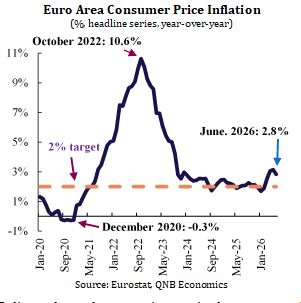
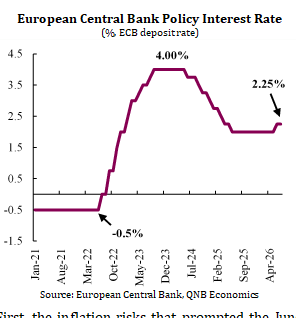
Policymakers became increasingly concerned that higher energy costs could spill over into the prices of other goods and services, making inflation more persistent through second-round effects. The Euro Area is particularly sensitive to natural gas prices, as gas not only constitutes a major share of energy imports, but also acts as a key price-setting factor in electricity markets. Against this backdrop, the ECB raised its deposit rate by 25 basis points in June, to prevent what was initially viewed as a temporary energy shock from becoming a broader inflation problem. These effects have for now been captured by monetary policy, unless a further and considerable spike in energy prices should prove more persistent. In this article, we discuss three key factors supporting this assessment.
First, the inflation risks that prompted the June rate hike have eased. Despite the ongoing conflict between the US and Iran, recent inflation data suggest that higher energy costs are not feeding broadly into the economy. Both headline and core inflation surprised to the downside in June, while wage growth continues to moderate, limiting the risk of second-round effects. Moreover, euro inflation swap rates – a market-based measure of investors’ inflation expectations – have fallen below the ECB’s 2% target over the next year. Taken together, these developments suggest that the inflation shock is likely to prove temporary, substantially weakening the case for further monetary tightening.
Second, the weakening growth outlook for the Euro Area reinforces the case for no further increases in policy rates. Business activity has remained subdued, with the composite Purchasing Managers' Index (PMI), which combines the manufacturing and services sectors, staying below the 50-point threshold that separates expansion from contraction for the past three months. This weakness has prompted analysts to revise down their growth outlook, with consensus forecasts for real GDP growth this year declining from 1.2% before the US-Iran conflict to 0.6%. Slower economic growth is also likely to reduce underlying inflationary pressures by dampening demand across the economy. Against this backdrop, additional monetary tightening would risk weighing unnecessarily on an already fragile economy.
Third, recent ECB communication suggests that policymakers are becoming more comfortable with leaving interest rates unchanged. At the June meeting, the Governing Council emphasized that it would continue to follow a data-dependent and meeting-by-meeting approach, without pre-committing to a specific path for policy rates. This message was reinforced at the ECB’s annual Forum on Central Banking, held in Sintra, Portugal, where central bankers, academics, and financial market participants gather each year to discuss the global economic outlook and monetary policy challenges. There, President Lagarde noted that risks to inflation and growth had become more broadly balanced. Other Governing Council members also indicated that a wait-and-see approach was appropriate, with some expressing openness to keeping policy rates unchanged if incoming data continue to confirm that inflation risks are receding. Taken together, recent communication suggests that the Governing Council is increasingly focused on assessing incoming data rather than preparing for another near-term increase in policy rates.
All in all, the ECB’s June rate hike was an appropriate response to the temporary inflation risks. Nevertheless, continued progress in the disinflation process, a weaker growth outlook, and recent ECB communication all point to a reduced need for additional monetary tightening. Unless a new inflationary shock emerges or underlying price pressures prove unexpectedly persistent, the June increase is likely to mark the end of the ECB’s tightening cycle, with policy rates expected to remain unchanged over the remainder of the year.
DISCLAIMER: The information in this publication (“Information”) has been prepared by Qatar National Bank (Q.P.S.C.) (“QNB”) which term includes its branches and affiliated companies. The Information is believed to be, and has been obtained from, sources deemed to be reliable; however, QNB makes no guarantee, representation or warranty of any kind, express or implied, as to the Information’s accuracy, completeness or reliability and shall not be held responsible in any way (including in respect of negligence) for any errors in, or omissions from, the Information. QNB expressly disclaims all warranties or merchantability or fitness for a particular purpose with respect to the Information. Any hyperlinks to third party websites are provided for reader convenience only and QNB does not endorse the content of, is not responsible for, nor does it offer the reader any reliance with respect to the accuracy or security controls of these websites. QNB is not acting as a financial adviser, consultant or fiduciary with respect to the Information and is not providing investment, legal, tax or accounting advice. The Information presented is general in nature: it is not advice, an offer, promotion, solicitation or recommendation in respect of any information or products presented in this publication. This publication is provided solely on the basis that the recipient will make an independent evaluation of the Information at the recipient’s sole risk and responsibility. It may not be relied upon to make any investment decision. QNB recommends that the recipient obtains investment, legal, tax or accounting advise from independent professional advisors before making any investment decision. Any opinions expressed in this publication are the opinions of the author as at the date of publication. They do not necessarily reflect the opinions of QNB who reserves the right to amend any Information at any time without notice. QNB, its directors, officers, employees, representatives or agents do not assume any liability for any loss, injury, damages or expenses that may result from or be related in any way to the reliance by any person upon the Information. The publication is distributed on a complementary basis and may not be distributed, modified, published, re-posted, reused, sold, transmitted or reproduced in whole or in part without the permission of QNB. The Information has not, to the best of QNB’s knowledge, been reviewed by Qatar Central Bank, the Qatar Financial Markets Authority, nor any governmental, quasi-governmental, regulatory or advisory authority either in or outside Qatar and no approval has been either solicited or received by QNB in respect of the Information.